Most drivers only think about volts on the day their car refuses to start. I know this because I coordinate roadside call-outs across Dubai, and nearly every one begins the same way: a driver, a silent engine, and a question they’ve never had to answer before, how many volts is my car battery even supposed to have?
The good news is that it’s one of the easiest things to understand about your car. Once you know the numbers, you can catch a dying battery days before it strands you. Let me walk you through it in plain language.
The Simple Answer: 12 Volts
A standard car battery is a 12-volt battery. That’s the number printed on the label and the one everyone quotes.
But here’s the twist that confuses people: a healthy 12-volt battery doesn’t actually sit at exactly 12 volts. The “12V” is just its name, its category. The real voltage moves up and down depending on whether the engine is off, running, or starting. Those small changes tell you everything about your battery’s health.
Resting Voltage vs Running Voltage
There are two numbers worth remembering.
Engine off (resting voltage). After the car has been switched off for a while, a fully charged battery reads about 12.6 to 12.7 volts. This is the number you check to judge the battery’s true state of charge.
Engine running (charging voltage). Once you start the car, the alternator kicks in and pushes the voltage up to roughly 13.7 to 14.7 volts. This higher reading is normal and healthy, it means the alternator is recharging the battery as you drive.
If your engine is running but you’re still seeing around 12 volts, the alternator may not be charging properly, and the battery is slowly draining even while you drive.
The Car Battery Voltage Chart
This is the part worth saving on your phone. With the engine off, here’s what your resting voltage tells you:
| Resting Voltage | Battery State |
|---|---|
| 12.6V – 12.7V | Fully charged |
| 12.4V | About 75% charged |
| 12.2V | About 50% charged |
| 12.0V | About 25% charged |
| Below 12.0V | Significantly discharged |
| Below 10.5V | Likely faulty — usually needs replacing |
When you crank the engine, it’s normal for the voltage to dip briefly to around 9 or 10 volts for a split second. That’s the starter drawing a big burst of power. What matters is that it recovers quickly.
How to Check Your Battery Voltage at Home
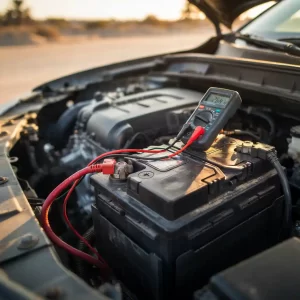
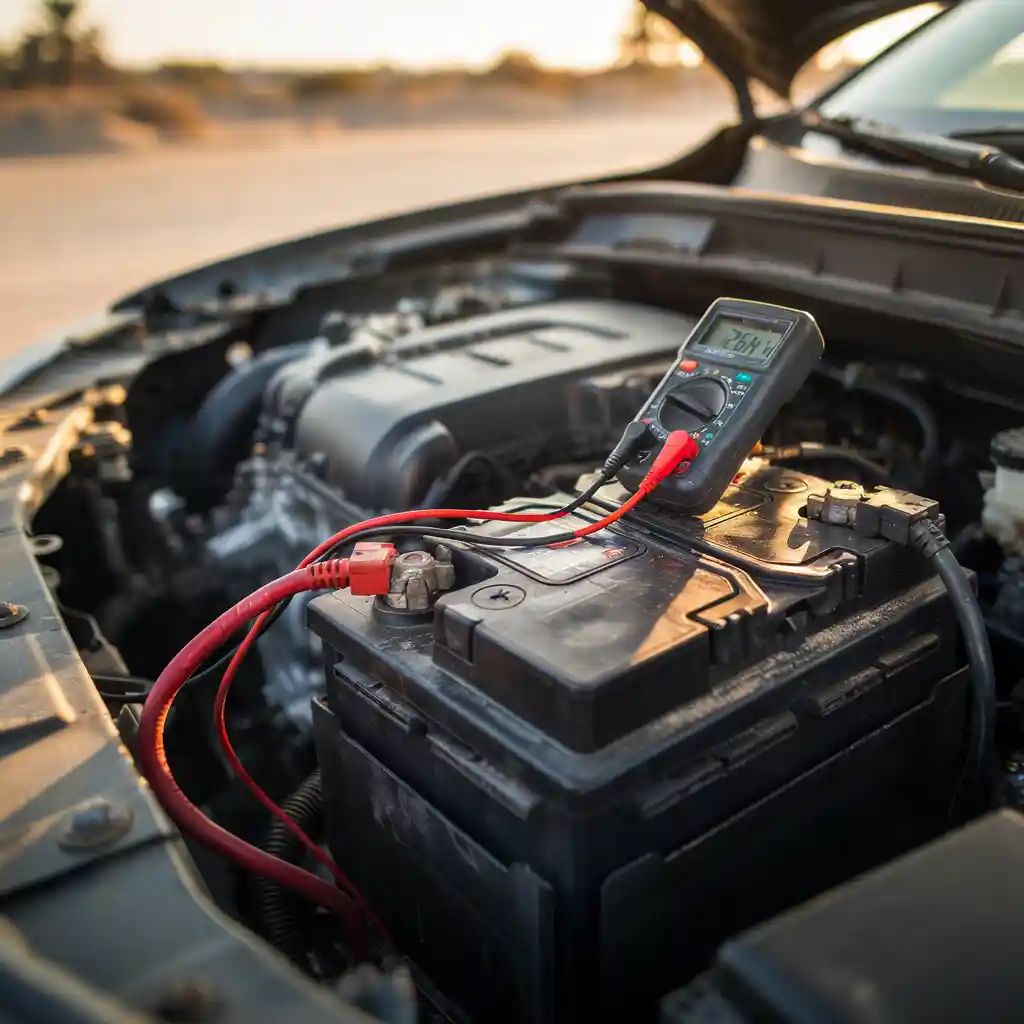
You don’t need to be a mechanic. A cheap digital multimeter is all it takes.
- Turn the car and all electronics fully off.
- Set the multimeter to DC volts (the 20V setting works well).
- Touch the red probe to the positive (+) terminal and the black probe to the negative (–) terminal.
- Read the number.
For the most accurate reading, test after the car has been sitting for a few hours, not right after a drive. If you want to check the alternator too, start the engine and look for that 13.7–14.7V range.
If numbers and probes aren’t your thing, that’s completely fine, our team checks battery voltage for free on every call-out.
What These Numbers Mean for You
Understanding voltage turns you from a driver who gets surprised into one who sees trouble coming.
A battery resting at 12.4V still starts the car, but it’s telling you it’s no longer at full strength. At 12.2V or below, you’re in the danger zone, especially overnight when a small drop can leave you unable to start in the morning. Catching these readings early means you can plan a replacement on your terms, not stranded on Sheikh Zayed Road at midnight.
For a deeper technical breakdown of how these 12-volt lead-acid systems work, the overview on the automotive battery is a solid reference.
Why Dubai’s Heat Plays With Your Voltage
Here’s what makes the UAE different. Extreme heat is one of the harshest environments for a car battery anywhere in the world. High temperatures speed up the chemical wear inside the battery, which means voltage starts slipping sooner than it would in a cooler climate.
That’s why local batteries often last just 2 to 3 years instead of 4 or 5. A battery that tested perfectly last winter can weaken fast during a brutal Dubai summer. So even if your car starts fine today, a quick voltage check before the hottest months is one of the smartest habits a UAE driver can build.
How Often Should You Check Your Voltage?
You don’t need to test daily, but a few well-timed checks save a lot of stress.
For most UAE drivers, I recommend a quick voltage check every three to six months, and always before the summer months when the heat does its worst damage. If your battery is already more than two years old, checking a little more often is wise, because that’s exactly the age when local batteries start to fade.
It’s also worth a check any time you notice the car cranking more slowly than usual, or after the vehicle has sat unused for a couple of weeks. Cars parked at the airport for a long holiday are one of the most common call-outs we get, the battery simply drains while it sits in the heat.
Voltage vs Cold Cranking Amps: What’s the Difference?
Voltage tells you how charged the battery is right now. But there’s a second number that matters: cold cranking amps (CCA), which measures how much starting power the battery can deliver.
A battery can show a healthy 12.6 volts and still struggle to start the car if its CCA has faded with age. This is why a proper battery test checks both, not just voltage. So if your readings look fine but the car still cranks slowly, don’t ignore it, the battery may be losing its punch even though the voltage looks acceptable. A full test at that point is the smart move.
Warning Signs Your Battery Voltage Is Dropping
Even without a multimeter, your car gives you hints. Watch for:
- Slow, lazy cranking when you start the engine.
- Dim headlights, especially at idle or when you switch on the AC.
- Dashboard battery warning light.
- Electronics acting up, like flickering screens or a weak-sounding horn.
- A car that starts fine in the evening but struggles the next morning.
Any one of these, combined with a low voltage reading, means it’s time to act. If the car has already died, our jump start service in Dubai can get you running again within about 15 minutes.
When Voltage Says It’s Time to Replace
If your battery consistently rests below 12 volts even after charging, or drops under 10.5 volts, charging won’t save it. The battery has reached the end of its life and needs replacing.
The safest move is a proper test followed by a genuine replacement matched to your car. A quality battery built for heat, like a genuine Varta car battery, is designed to hold voltage far better through UAE summers. For a full fitting at your location, our car battery replacement in Dubai covers every area of the city.
Frequently Asked Questions
Is 12.4 volts okay for a car battery? It’ll start the car, but it’s only around 75% charged. Fine for now, but worth watching, especially in summer.
What voltage is too low to start a car? Once resting voltage drops below about 12 volts, starting becomes unreliable. Below 11.8V, many cars won’t crank at all.
Should the voltage be higher when the engine runs? Yes. Around 13.7 to 14.7 volts with the engine on is normal, that’s the alternator charging the battery.
Do electric and hybrid cars use 12V batteries too? They have a large high-voltage battery for driving, but they also carry a separate 12V battery for the lights, electronics, and computers, just like a regular car.
The Bottom Line
A car battery is a 12-volt battery, but the real story is in the details: about 12.6 to 12.7 volts when fully charged and resting, and 13.7 to 14.7 volts while the engine runs. Anything drifting below 12 volts is a warning worth taking seriously, especially in the UAE’s heat.
Keep that voltage chart handy, test your battery before summer, and if the numbers look low, don’t wait for a breakdown. Talk to our Dubai battery team and we’ll test, advise, and if needed replace your battery on the spot, wherever you are.